
Your home energy efficiency playbook.

Your complete guide to air conditioning, ducts sealing, air sealing, insulation and HVAC maintenance.
Index
Click on the links to jump to the sections that are most relevant to your long-term home energy efficiency and money-saving goals.
Introduction
Chapter 1: Duct sealing & ductwork maintenance
Chapter 2: Air sealing your house & attic (AKA: Home envelope sealing)
Chapter 3: Home & attic insulation solutions
Chapter 4: High efficiency HVAC & central air conditioning
Chapter 5: Seasonal HVAC maintenance & tune-ups
Chapter 6: How to hire a qualified contractor
Glossary
References
Whether you’re a renter, homeowner or landlord who’s considering upgrading aging systems, understanding the fundamentals of home energy efficiency is important. We’re working closely with local power companies throughout the seven-state Tennessee Valley region to help people like you lower your energy bills with energy-saving recommendations, rebates and more.
Although we often think about each of these systems individually, they all work together to improve comfort, protect indoor air quality, lower your monthly heating and cooling costs, and extend the effective lifespan of your HVAC system.
That’s why we’re taking this opportunity to put everything you need to know about duct sealing, air sealing, insulation and HVAC in one place for easy reference. We hope you’ll find this comprehensive playbook useful and share it with your neighbors!
As you read through this guide, you’ll find expert-backed tips from energy authorities like ENERGY STAR, the U.S. Environmental Protection Agency (EPA), research publications and building-science standards from Air Conditioning Contractors of America (ACCA). Feel free to click around and keep on learning from trusted sources.
And don’t forget duct sealing, air sealing, insulation and HVAC maintenance all qualify for rebates from TVA EnergyRight and your local power company. You can search our Quality Contractor Network for TVA-vetted, licensed and insured contractors near you who can help you apply for valuable rebates on home energy upgrades.
Chapter 1: Duct sealing & ductwork maintenance.
Duct sealing key takeaways:
- Rebates of up to $300 are available on duct sealing.
- Leaky ducts can allow up to 30% of your conditioned air.
- If your home has hot or cold spots, or your energy bills are higher than usual, it may be time to check your ducts.
What is duct sealing, and how much energy can duct sealing save?
Losing conditioned air as it travels through your home is hard on your home energy bills and your personal comfort. Unfortunately, it’s an incredibly common way for energy loss to occur. Research shows that leaky ducts can lose a staggering amount of conditioned air — up to 30% — as it travels through the system.
Not only does this waste lead to higher energy bills, but it also means your HVAC system is working much harder than it needs to. Ducts leaking just 20% of conditioned air passing through them can cause your heating and cooling unit to work 50% harder!
Reading the signs: How do you know if your ducts are leaking?
What you can’t see can hurt your energy bill. For the most part, your home’s ductwork won’t be visible to you. However, just because you can’t see a crack or feel a leak doesn’t mean your home won’t give you some helpful signs that maintenance is needed. If any of the following symptoms sound familiar, it may be time to consult with your local heating and cooling expert.
- Higher-than-normal or unpredictable energy bills.
- Difficulty maintaining your desired temperature.
- Hot or cold spots or drafty rooms.
- Noticeable dustiness.
- Whistling or whooshing sounds when your HVAC runs.
- Dirt, dust, mold or condensation around air vents.
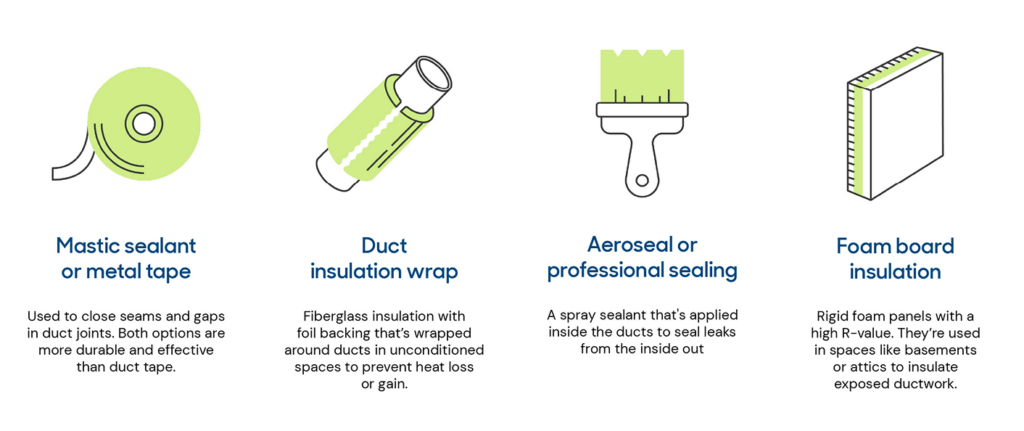
It may be tempting to run to your local hardware store and grab a roll of standard duct tape (quick note here: mastic sealant or metal tape are both more efficient, longer-lasting options), but unless you really know what you’re doing with your ductwork, you may want to leave maintenance to the professionals.
Best practices for duct sealing.
Use mastic sealant or foil-backed duct tape to seal all joints, seams and connections. Check out our duct sealing upgrade page for more information. When you insulate ducts that run through unconditioned spaces such as your attic, crawl spaces and garage, you can reduce thermal loss.
When to call a duct sealing pro.
If you’re not confident in your DIY skills, if ducts run through hard-to-access areas, or need extensive sealing, a professional familiar with ACCA standards or local building codes is the way to go. If you suspect disconnections or serious leakage, you should look for a trusted expert. Plus, they’ll also have the equipment to run pre- and post-sealing leakage testing to help ensure the best results.
Rebates on duct sealing are now available and you can find a contractor who can help you with AC ductwork sealing and rebates by searching the Quality Contractor Network!
Chapter 2: Air sealing your house & attic.
Air sealing key takeaways:
- Rebates of up to $300 are available on air sealing.
- Sealing gaps creates a barrier between the inside of your home and the outside, keeping conditioned air inside.
- Air sealing and insulation can reduce heating and cooling costs by an average of 15%.
What is air sealing? And why air sealing matters.
Air sealing is the process of closing small cracks, gaps and holes in your home’s building envelope — the barrier between indoors and outdoors. It’s especially important to have older homes inspected, but new construction shouldn’t get a free pass! As new homes settle, cracks and gaps often appear. Consequently, sealing up these gaps before winter (or summer) can dramatically reduce drafts, energy loss and discomfort.

Where to find air leaks in homes:
- Attic and crawlspace hatches.
- Window and door frames, sashes, jambs, sills.
- Plumbing and electrical penetrations (pipes, wires).
- Recessed lights, vents, fans and vent ducts.
- Around baseboards and where walls meet ceilings.
- Refrigerator, dishwasher or exhaust fan penetrations.
- Outlets, switch boxes and vent registers.
How to detect air leaks.
DIY-friendly and renter-friendly method.
For a low-cost preliminary check, you can take the DIY route. Here’s how:
- On a windy day, close all windows and exterior doors. Turn on exhaust fans (bathroom, kitchen hood).
- Light an incense stick (or use a damp hand) and slowly move around door frames, window edges, baseboards — feel or watch for air movement.
- Common leaks are at doors, windows, attic hatches, rim joists, plumbing or wiring penetrations and vents.
Want to get your kids in on the fun? Check out “Calling all junior detectives! Use your sleuthing skills to spot sneaky leaks.”
How much can air sealing save you?
Lower energy bills: According to ENERGY STAR, air sealing and insulation can reduce heating and cooling costs by an average of 15%, and in some cases even more.
Improved comfort: Cut down on drafts, promote more stable indoor temperatures, reduce cold spots and take the burden off your HVAC systems. You can learn more about R-value (the higher the R-value, the greater the material’s insulating power) and find your climate zone on the Department of Energy’s website.
Better indoor air quality: Sealing leaks reduces infiltration of dust, pollen, mold spores, moisture and pests — which is especially relevant if vents, crawlspaces or attics are connected to living spaces.
Moisture and maintenance: Sealing leaks and home weatherization help prevent condensation, mold, mildew and structural damage from moisture infiltration.
Best practices for air sealing.
You don’t have to do everything at once! Remember, every improvement helps. To get started, we recommend focusing on key areas that can make the biggest difference.
Seal doors and windows.
- Use weatherstripping around doors and movable window sashes.
- Apply caulk to seal cracks around stationary window frames and exterior trim.
- Install door sweeps to block drafts at the bottom of exterior doors.
- Apply window film to especially drafty windows.
Address the attic and crawlspace.
- Look for gaps around plumbing vents, electrical wiring and chimneys in your attic.
- Use expanding foam or caulk to seal small holes and install covers or gaskets where needed.
- In crawlspaces, sealing gaps between the foundation and framing can stop cold air from entering your floors.
Fortunately, rebates on air sealing are available from TVA EnergyRight and your local power company!
Chapter 3: Home & attic insulation solutions.
Insulation key takeaways:
- Rebates of up to $300 are available on insulation.
- 9 out of 10 homes in our region are under-insulated.
- The higher the R-value, the better the insulating power.
Uneven temperatures, drafty rooms and high (or unpredictable) energy bills could mean your home is under-insulated or letting your conditioned air out and unconditioned air in. Shockingly, nine out of 10 single-family detached homes in the U.S are under-insulated (ENERGY STAR)!
What is insulation?
Insulation slows heat flow (via conduction, convection or radiation), helping keep warm air in during the winter or out during the summer months. Proper insulation reduces the load on your HVAC system and lowers energy use.
Types of Insulation.
The type of insulation you use may depend on where it’s being installed and your home’s specific needs. Some common insulation types include:
Blown-in (loose-fill) insulation
Ideal for attics and wall cavities, this type of insulation is made of fiberglass or cellulose and is blown into place using special equipment.
Batt insulation
These pre-cut panels of fiberglass or mineral wool are one of the most affordable and widely used forms of insulation. They’re ideal for open areas like between wall studs, floor joists and attic rafters.
Spray foam insulation
Expands to fill gaps and create a tight air seal. Available in open-cell and closed-cell varieties, spray foam is especially effective for sealing around pipes, wiring and small crevices.
Foam board insulation
Rigid panels made of polystyrene or polyurethane are typically used on foundation walls, basement interiors and exterior walls under siding. Foam boards offer high insulating value with a relatively thin profile.

What does insulation R-value mean?
Insulation is measured in R-values, which indicate its resistance to heat flow — the higher the R-value, the better the insulation power. Visit our insulation and air sealing upgrade page for more information.
In the South, many homes are under-insulated — especially older houses. If the floor joists are exposed in your attic, for example, that’s a strong indication that you need additional insulation. Fortunately, rebates are available.
Insulation works best when the building envelope is tight. Installing insulation first, then sealing leaks, can leave gaps behind insulation or make leaks harder to find. Professionals and building-science guidance recommend sealing first, then insulating.
Where should you consider insulating or improving your existing insulation?
Attic insulation
Attic insulation can help regulate your home’s temperature all year long; plus it can help prevent moisture buildup, which could lead to mold or structural damage. Consider blown-in cellulose or fiberglass batt insulation to reach the recommended R-values for your region.
ENERGY STAR recommends hiring a qualified insulation contractor to make sure your attic is well-sealed and properly insulated, with the correct insulation levels and insulation type for your home’s age and construction. You can search the Quality Contractor Network for TVA-vetted insulation contractors near you.
Crawlspace insulation
Insulating between the floor joints of your crawl space not only helps keep your toes warm in the winter, but it also improves energy efficiency year-round, helping you save money.
Wall insulation
Proper wall insulation helps you save on heating and cooling costs, but it doesn’t stop there — it also improves soundproofing and offers a degree of moisture control that can minimize mold and mildew. Wall insulation is harder to retrofit, but it’s possible with dense-pack cellulose or foam injection. Or, if your home needs to be resided, that’s a great time to consider adding insulation as well!
You don’t always need a full insulation overhaul. For example, simply topping off attic insulation or insulating around rim joists can make a big difference. Not sure where to begin? A member of our Quality Contractor Network can help.
For maximum efficiency, we recommend combining air sealing with insulation upgrades.
Chapter 4: High efficiency HVAC & central air conditioning.
Air conditioning key takeaways:
- Rebates of up to $400 are available on high-efficiency air conditioning systems.
- Air conditioners help control humidity.
- Systems that are 10+ years old are less efficient than modern models.
How does a high-efficiency AC system improve comfort?
If you live in a home without central air conditioning, an upgrade will be an undeniable improvement! And if your existing air conditioner is more than 10 years old, it may be working overtime without keeping you comfortable. Many older systems also often lack variable-speed technology and precision controls that today’s high-efficiency air conditioners use to maintain steady, consistent comfort throughout your home.
Modern high-efficiency AC systems, especially ones that are rated at 15 SEER2 or higher, are built to do more than just cool: They modulate their output based on what your home actually needs at any given moment, rather than cycling on at full blast and shutting off suddenly.
Steadier, even operation leads to more consistent temperatures and humidity levels throughout your home.
For more on how humidity impacts comfort, check out “Humidity, heat and your home: How SEER2 15+ systems tackle our region’s tough conditions,” and “How high-efficiency AC systems and duct sealing eliminate hot spots.”
Be sure to check out rebates on high-efficiency air conditioners from TVA EnergyRight and your local power company.

Chapter 5: Seasonal HVAC maintenance & tune-ups.
HVAC tune-up key takeaways:
- $50 rebates are available on HVAC tune-ups.
- Tune-ups help your system run more efficiently.
- Routine maintenance can help reduce the need for emergency repairs.
HVAC maintenance is essential for comfort, safety and efficiency — and helps prevent unexpected breakdowns when you need your system the most. That’s why we recommend scheduling a tune-up twice a year — once in fall before heating season and once in spring before cooling season. Certainly, if you notice strange sounds coming from your unit and higher-than-normal bills, call in the pros regardless of whether or not your inspection is due.
Why does seasonal HVAC maintenance matter?
If you have your home air sealed or insulated, it may be a good idea to add a tune-up to the list. Why? Because home envelope sealing may change airflow and pressure dynamics, which can affect how your system operates.
Why does seasonal HVAC maintenance matter?
- Avoid costly emergency repairs — A well-tuned system is less likely to break down during extreme cold or heat.
- Improve energy efficiency: Clean systems run more efficiently and maintenance can catch issues (dirty coils, malfunctioning parts, airflow restrictions) that cause efficiency losses.
- Enhance indoor air quality: Regularly changing or cleaning filters helps trap dust, pollen and other particles rather than circulating them throughout the home.
- Extend equipment lifespan: Routine maintenance reduces wear and tear and lets you catch small problems before they become major.
- Ensure safety: Technicians can inspect for gas leaks, cracked heat exchangers, faulty wiring or improper ventilation — especially important if you have combustion appliances.
- Peace of mind: Proper airflow, clean components, calibrated thermostats — all lead to a more consistent, comfortable indoor environment.
- Take advantage of rebates: Get $50 off HVAC maintenance with a rebate from TVA EnergyRight and your local power company.
- Save money: Using less energy, helping your HVAC system last longer and taking advantage of rebates all add up to saving money.
What does a typical HVAC maintenance visit include?
Chat with your HVAC technician to make sure their inspection includes the following:
- Filter inspection/change.
- Coil cleaning (evaporator and condenser).
- Checking refrigerant levels (for cooling systems / heat pumps).
- Lubricating moving parts.
- Inspecting electrical connections and wiring.
- Testing safety controls, airflow and thermostat calibration.
- Checking defrost cycles and reversing valve in heat pumps.
Chapter 6: How to hire a qualified contractor.
Upgrades like duct sealing, air sealing, insulation and HVAC maintenance/installation often benefit from a trained, licensed and experienced contractor — especially when you want quality, safety and long-term performance.
What should you look for in a trusted contractor?
We hope you’ll take advantage of our Quality Contractor Network (QCN) to find a TVA-vetted contractor near you. As you think about home energy efficiency upgrades and consider your options for a qualified contractor, keep the following recommendations in mind:
Licensing & insurance: Ensures compliance with state/local codes and protects you in case of accidents. (Members of the QCN are licensed and insured.)
Proven experience: Specifically, look for experience with the system and climate you have — whether that’s traditional furnaces/AC, heat pumps, ductless mini-splits or combinations.
Knowledge: They should have demonstrable knowledge of energy-efficiency standards and building science (air sealing, insulation, load calculations, duct sealing, ventilation).
Customer references and positive reviews: Look for consistency, on-time accolades and comments about professionalism, transparency and good communication.
Clear written estimates: Your quote should include labor, materials and scope of work; no vague or open-ended pricing.
Training: They should be willing to show their certifications or talk about their training.
Transparent communication and customer care: You should feel like they’re listening to you and explaining their work in clear terms.
Glossary
ACCA: Air Conditioning Contractors of America; publishes national HVAC installation and quality standards.
Air Sealing: The process of closing leaks, cracks and gaps in a home’s building envelope to prevent unintended airflow.
Blower Door Test: A diagnostic test using a powerful fan mounted in an exterior door to depressurize a home and identify air leaks.
BTU: British Thermal Unit; a measure of heating or cooling output.
Combustion Safety Test: Inspection of gas-fired appliances to ensure proper ventilation and safe exhaust.
Duct Sealing: Repairing and sealing HVAC ductwork to prevent air leaks and improve airflow efficiency.
ENERGY STAR: A U.S. government-backed symbol for energy efficiency, managed by the EPA and DOE.
Heat Pump: A heating/cooling system that moves heat in or out, rather than generating it via combustion.
HVAC: Heating, Ventilation and Air Conditioning
Load Calculation (Manual J): A standardized method (published by ACCA) to determine the correct size HVAC system for a home.
Mastic: A durable sealant used to seal ducts; more effective and long-lasting than standard “duct tape.”
QCN: Quality Contractor Network; a network of TVA-vetted, licensed and insured contractors who can help you with home energy upgrades and applying for rebates.
R-value: A measure of an insulation material’s resistance to heat flow; the higher the R-value, the better its thermal resistance.
SEER2: Seasonal Energy Efficiency Ratio; a metric for air conditioner/heat pump cooling efficiency (new standard).
Supply/Return Ducts: The ducts that deliver conditioned air to living spaces (supply) and return air back to the HVAC system (return).
10 signs your home is losing heat this fall.

You know what the best season is? It’s shoulder season. That’s the magical in-between time of the year when you start the day in your favorite hoodie, spend the afternoon in flip-flops and end the day back in that fuzzy sweatshirt. Best of all: That season is now!
However, as the days begin flip-flopping between warm afternoons and chilly mornings, your home may start sending you reminders that winter is on its way.
And when that first cold snap hits, most of us do the same thing: cross our fingers and turn the heat on. (Hopefully you’ve scheduled your annual HVAC tune-up — there’s a rebate for that! — so there shouldn’t be any surprises!)
But once your system is up and running, if some rooms still feel chilly, or your heat is on longer than you expected, your home may be trying to tell you something.
That “something” is usually energy loss, and it’s more common than you’d think. Fortunately, we speak the same language as your home, and we can help you figure out what it’s saying. Here are 10 signs your home is losing energy, plus what you can do to fix it before winter really settles in.
What to keep an eye, ear and hand out for as the temperature starts to drop.
You’ve probably gotten into your air conditioning groove over the last few months, so heating mode can take some getting used to — and that’s probably why you’re more attuned to changes in the hallway’s temperature, hot bedrooms and bills that don’t quite add up.
1. You can feel a draft near doors and windows.
Hold your hand near the edges of an exterior door or window frame on a windy day. Feel a breeze? That’s outside air finding its way in — and your heated air finding its way out.
2. Cold air seems to creep up from your baseboards.
Baseboards are one of the most overlooked spots for air leaks. Gaps between the baseboard and the floor or wall can let conditioned air (whether it’s warmed or cooled) slip out of living spaces and into unconditioned areas such as walls or crawl spaces.
3. You can see daylight around a door or window frame.
This one’s simple: if light can get in, so can air. Visible daylight around a doorframe or window sash is one of the clearest signs of a leaky seal.
4. Some rooms never feel as warm as others.
If your living room is toasty but the guest room down the hall feels like a walk-in cooler, uneven heating is often a sign of air leaks or insufficient insulation in that part of the house.
5. Your heat seems to be running constantly.
If your HVAC system is cycling on and off more than usual, or running nonstop as it tries to reach your set temperature, it may be fighting a losing battle against warm air escaping through leaks.
6. Your energy bill doesn’t look quite right.
A bill increase is normal once the heating season starts. But if your bill spikes dramatically compared to last year, air leaks and poor insulation are common (and fixable) reasons why.
7. Your dust cloth is getting a workout.
If you notice dust or debris gathering near vents, outlets or baseboards, something’s up. Air doesn’t just leak out — it can also suck dust and debris in through the same gaps, leaving a telltale buildup near outlets, vents and along baseboards.
8. Doors and windows are hard to open or close.
Frames that have shifted or warped over time often develop gaps you can’t always see but can definitely feel — both in the draft and in the extra effort it takes to shut the door.
9. Your floors feel unusually cold, even with the heat on.
Cold floors, especially over a crawl space or basement, can point to air leaks and insufficient insulation working against each other.
10. You can hear the wind outside a little too clearly.
If you can hear outdoor noise (or feel a slight whistle) around a window or door frame, air is very likely moving through that same gap.
If your home has been chatting about any of these things, then it’s a good bet you have some air sealing to catch up on.
What’s actually causing all this? (Spoiler alert: air leaks.)
Air leaks occur when gaps and cracks form around the parts of your home where different materials meet — doors, windows, baseboards, plumbing penetrations, electrical outlets and more.
Over time, homes settle, materials contract and expand with the seasons, and caulk or weatherstripping age and crack. None of this happens overnight, which is why it’s easy to miss until the weather changes and your heating system starts working harder to compensate.
The upside is that air sealing is one of the easiest and most affordable ways to improve comfort and lower energy costs.
Sealing up gaps helps your heating system do its job more efficiently, wasting less heat.
Want a deeper dive into how air sealing and insulation work together to keep your home comfortable all winter? Check out our guide on air sealing and insulation tips to get your house knitted up for sweater weather.
Getting your home ready for winter.
Once you’ve translated what your house is saying, here’s what you can do about it.
Start with the easy wins. Weatherstripping, door sweeps and caulk are inexpensive, DIY-friendly solutions that can seal up smaller gaps around doors, windows and baseboards. All it takes is a trip to the hardware store and a free afternoon.
To get a clearer picture of where you’re losing energy, take our free DIY Home Energy Assessment or schedule an in-person Home Energy Evaluation for tailored energy-saving recommendations.
Attics, crawl spaces and areas around recessed lighting or plumbing are trickier to seal on your own. Don’t hesitate to bring in a pro for the big upgrades like insulation, duct sealing or professional home envelope air sealing. T
Not sure who to call? Our blog on finding trusted help for your home energy upgrades walks you through how the Quality Contractor Network works and how we’re making it easier than ever to find a licensed, TVA-vetted contractor near you.
Don’t let a few small gaps turn into a big winter bill.
Slipping into your favorite team’s hoodie for the season is a sure sign that it’s time to check in on your home and take care of your comfort … and heating system.
Whether you tackle a little weatherstripping yourself or bring in a member of the Quality Contractor Network for a bigger energy upgrade, taking action now means a more comfortable, more efficient home all winter long.

Electrification versus efficiency: Where should industrial facilities focus first?

According to the U.S. Department of Energy (DOE), the industrial sector accounts for about one-third of U.S. energy-related carbon dioxide emissions, making industrial energy strategy a high-impact area.
As industrial facilities look for ways to meet sustainability goals, optimize operations and invest in energy efficiency, moving certain equipment and processes to electricity can potentially be a smart long-term strategy.
But for many facilities, electrification may not be the best first move.
Before changing how energy is supplied for a facility, it often makes sense to look at how energy is being used right now. In many industrial environments, efficiency improvements can deliver faster returns, lower risk and clearer operational benefits. They can also make future electrification decisions easier, more affordable and more effective.
The question is not whether electrification or efficiency matters more. The better question is: what should come first?
Sources: energy.gov; epa.gov
Electrification has an important role to play.
Electrification can be a powerful tool in the right applications. For some facilities, replacing fuel-powered equipment with electric alternatives can help support sustainability goals, reduce on-site emissions and improve long-term energy flexibility.
It can be especially worth exploring when equipment is already nearing the end of its life, when electric alternatives are proven and available, or when leadership is building a long-term plan around emissions reduction and modernization.
Examples of electrification opportunities include electric forklifts, certain heat pump applications, electric process equipment where technically feasible, or infrastructure planning that prepares the site for future electric loads.
But electrification is rarely a simple swap. It can require capital investment, engineering review, electrical capacity planning and a close look at how changes may affect demand, production schedules and operating costs. That does not mean industrial facilities should avoid electrification. It means they should approach it with a clear plan.
Sources: powermag.com; industrialinnovation.org
Efficiency often delivers the fastest practical wins.
Efficiency is usually less flashy than electrification, but it can be one of the most practical places to start.
Instead of replacing entire systems or changing fuel sources, efficiency focuses on reducing waste and improving the performance of what is already in place. For many facilities, that can mean upgrading lighting, improving compressed air systems, optimizing HVAC, adding variable speed drives, improving controls or using commissioning to fine-tune systems that use more energy than they should.
These projects often have a more straightforward business case. They can reduce energy use, lower maintenance costs, improve visibility or comfort, and help equipment operate more reliably.
The results are not theoretical. DOE’s Better Plants Program encourages manufacturers and water utilities to set long-term goals to achieve significant energy and water intensity improvements over a 10-year period across all their U.S. operations.
Oak Ridge National Laboratory reports that DOE Better Plants partners have achieved $11.8 billion in cumulative cost savings, 2.4 quadrillion BTUs in energy savings and 147 million metric tons of CO₂ avoided.
Efficiency upgrades can also be easier to phase. A facility may not be ready for a major electrification project across the plant, but it may be ready to replace outdated lighting in a warehouse, repair compressed air leaks, improve motor controls or evaluate high-use systems.
That matters because industrial teams are rarely making energy decisions in a vacuum. They are balancing production goals, capital budgets, maintenance needs, safety priorities and leadership expectations. Investing in efficiency gives industrial facilities a practical way to make progress without waiting for the perfect long-term plan.
Sources: energy.gov; ornl.gov
Why efficiency often comes first.
For many industrial facilities, improving efficiency before electrifying creates a stronger foundation. Here’s why.
Energy efficiency lowers the load before adding new demand.
Electrification can increase the electric load. If a facility adds new electrical equipment without first addressing waste, it may be building on an inefficient baseline.
According to The American Council for an Energy-Efficient Economy (ACEEE), a nonprofit research organization, planning for added electrical load is a key best practice for electrification, which reinforces why facilities should understand and reduce waste before adding new demand.
Efficiency improvements help reduce unnecessary energy use first. That can make future electrification easier to plan and, in some cases, reduce the size or cost of the infrastructure needed to support it.
Use less first, then decide what to add.
Sources: acee.gov
Investing in efficiency can improve your business case.
Many efficiency projects can deliver measurable savings faster than larger infrastructure changes. Lighting upgrades, compressed air improvements and system optimization can often show a clearer connection between investment and return.
A 2025 International Energy Agency (IEA) survey of 1,000 industrial facilities found that energy efficiency investments are paying off. About 70% of respondents reported ROI above 10% on efficiency upgrades made in the past five years.
Those savings can also support future projects. When a facility reduces waste and lowers operating costs, it may create more room in the budget for larger energy investments down the road.
It’s not an either/or choice between efficiency and electrification. Efficiency can help pave the way toward electrification.
Efficiency can reveal what your facility actually needs.
An energy strategy should be based on real facility conditions, not assumptions.
Efficiency often starts with data, assessments or system reviews. That process can uncover where energy is being wasted, which systems are underperforming and which upgrades are likely to have the greatest impact.
Benchmarking can also help teams avoid guesswork. ENERGY STAR’s plant performance tools use actual plant data to show how efficiently a facility operates compared with similar plants.
These insights are valuable whether the next step is an LED lighting upgrade, a compressed air project, a controls improvement or a future electrification study.
Efficiency gives teams a clearer map before they make bigger moves.
Sources: acee.org; energystar.gov; iea.org
The smartest facilities are sequencing both.
Industrial facilities do not have to choose efficiency or electrification forever. In many cases, the strongest strategy is to sequence both. In fact, the DOE’s own industrial roadmap does not frame the path forward as efficiency or electrification. It encourages both as key pathways, alongside low-carbon fuels and carbon capture.
A practical roadmap might look like this:
1. Assess your current performance.
Start by understanding where energy is being used, where waste may be happening and which systems are creating the highest cost or maintenance burden.
2. Prioritize high-impact efficiency projects.
Look for improvements that can reduce energy use, lower maintenance needs, or improve operations, backed by a clear business case.
3. Optimize how systems run.
Controls, scheduling, monitoring and energy management practices can help ensure savings last and systems continue to perform as intended.
4. Evaluate electrification where it makes sense.
Once you reduce waste and understand plant performance better, you can make electrification decisions with more confidence.
Source: energy.gov
A better first question.
Instead of asking, “Should we electrify?” industrial teams may be better served by asking, “What should we improve first?”
For some facilities, the answer may be electrification. For many others, the answer may be efficiency, optimization or a closer look at systems that have not been evaluated in years.
The best path depends on the facility, the equipment, the goals and the budget. But in most cases, reducing waste first makes every next move stronger.
Electrification may be part of the future. Efficiency helps make that future easier to reach.
For industrial teams building an energy roadmap, TVA EnergyRight® can help identify practical opportunities, from assessments and incentives for equipment upgrades to long-term energy management strategies. But the starting point is simple: understand where your facility stands today, then choose the next move that delivers the clearest value for your operation.
Your next move starts here.
Get a no-cost assessment for your facility or connect with a TVA Energy Expert to plan your next improvement.
The hidden cost of running systems after hours.

Your business space is often “on” when no one’s there.
Many businesses focus on what happens during operating hours, but the biggest waste may happen when no one is there to notice it. Lights stay on, HVAC systems keep empty rooms heated or cooled and temporary overrides become permanent habits.
After-hours energy use is easy to miss because it doesn’t usually disrupt your operations, but it can quietly increase monthly costs and put unnecessary strain on equipment.
If your space is “on” when your business is closed, you may be paying for energy that is not helping your customers, employees or operations.
The good news? You do not have to overhaul your entire building to find savings. In many cases, the smartest first step is simply asking: What’s still running when no one is here?
Why after-hours waste is so easy to miss.
Energy waste often hides in your daily routine. A business may have reasonable operating hours, but systems may not be programmed to match them. A shop may close at 6 p.m., but the HVAC system may stay in occupied mode until midnight. Or an office may be empty on Saturdays, but lights and thermostats may still follow weekday settings. Some restaurants may need certain back-of-house systems running after close, while the dining area no longer needs the same level of heating, cooling or lighting.
Here’s why this happens:
- Businesses change hours but do not update controls.
- Employees manually override HVAC or lighting schedules and forget to reset them.
- Cleaning crews, delivery windows or maintenance visits extend system run times.
- Older controls may be difficult to adjust or may not reflect real occupancy.
- Owners and managers may not have visibility into when energy is actually being used.
For small and medium-sized businesses, everyone is busy. Scheduling gaps happen because energy management is rarely someone’s only job. Owners and managers are focused on staffing, customers, inventory and the daily realities of keeping the business moving. Updating schedules and checking controls can easily fall to the bottom of the list.
The most common after-hours mistakes.
1. Lighting that stays on longer than needed.
Lighting is one of the easiest places to spot after-hours waste. Indoor lights, parking lot lights, signage, exterior security lighting and back-of-house areas can all add up.
Of course, some lighting is important for safety, security and visibility. The goal is not to turn everything off. The goal is to make sure the right lights are on, at the right level, at the right time.
That might mean adding occupancy sensors in storage rooms or restrooms, using timers for signage, installing daylighting controls in areas with strong natural light or zoning lighting so an entire building is not fully lit when only one area is in use.
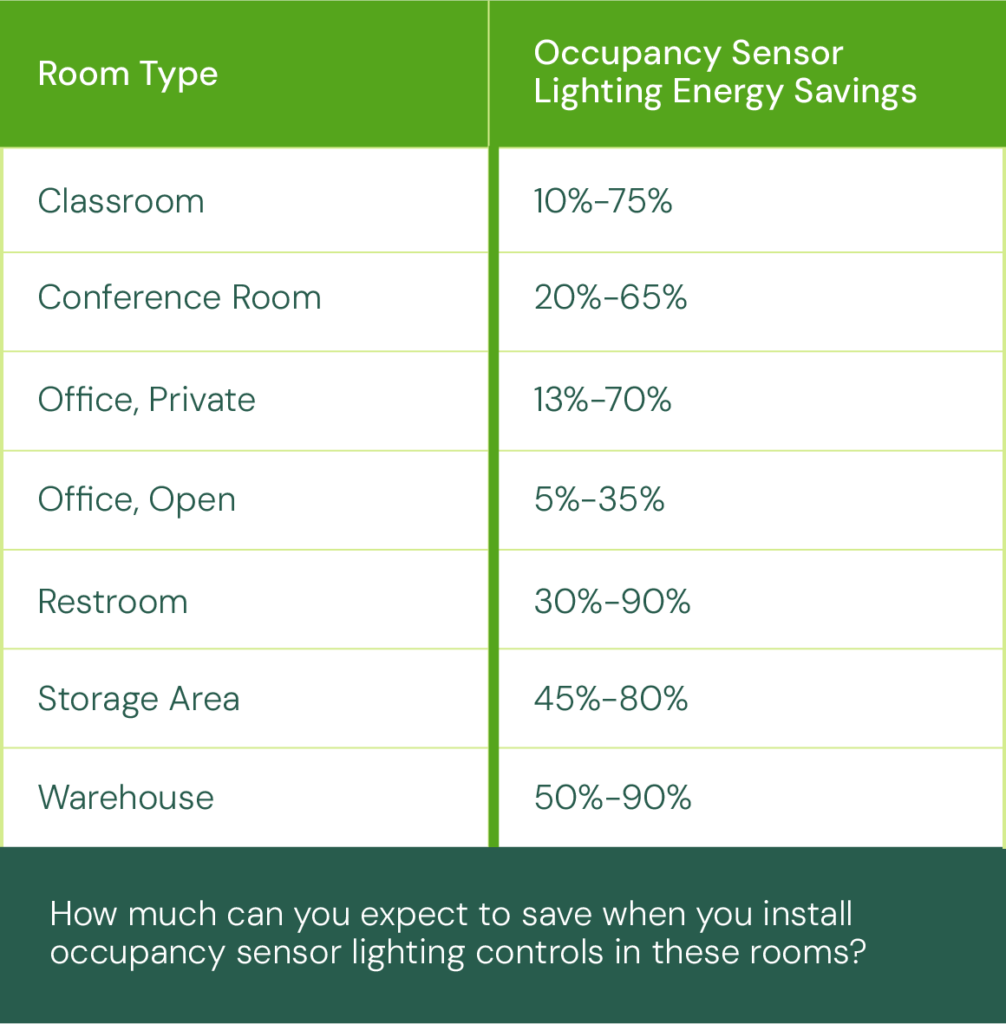
Action item: In addition to adding sensors, consider upgrading to LED lighting. LEDs can make a meaningful difference. They use less energy than traditional lighting and produce less heat, which may also help reduce strain on cooling systems during warmer months.
2. HVAC systems that do not match business hours.
Heating and cooling empty spaces can be one of the most expensive forms of after-hours waste. HVAC schedules may be set too broadly, run on weekends unnecessarily or fail to account for seasonal changes.
Common examples include:
- A retail space is cooling at the same level overnight.
- An office building runs HVAC on Saturdays even when no one is there.
- A restaurant keeps dining areas conditioned long after close.
- A clinic or professional office uses a single schedule for the entire building, even when only a few rooms are occupied.
Programmable or smart thermostats can help businesses better match heating and cooling to real occupancy. According to the U.S. Department of Energy, turning your thermostat temperature down by 7°–10°F for eight hours a day can save as much as 10% a year on heating and cooling.
Action item: If a space is empty, it probably does not need to be heated or cooled the same way it is during peak operating hours. Invest in smart thermostats and review your off-hours settings.
3. Manual overrides that become the new normal.
Manual overrides can be useful. A late meeting, maintenance visit or unusually hot day may require a short-term adjustment. The problem starts when no one checks whether those changes were reset. A thermostat override for one evening can become the new normal when a temporary setting for an event can quietly run for months.
Action items: These small issues are not always obvious, but they can add up. Building a simple review process can help.
- Check thermostat settings monthly.
- Review lighting schedules when business hours change.
- Make sure overrides expire automatically when possible.
- Assign someone to own the schedule so systems do not run by default.
For more tips, review this office checklist from the Federal Energy Management Program at the Department of Energy.
4. Other equipment may be running, too.
Lighting and HVAC are often the easiest places to start, but they are not the only sources of after-hours energy use.
Depending on the business, compressors, refrigeration equipment, exhaust fans, water heaters, vending machines, kitchen equipment, office equipment or other systems may also run longer than needed. Some of that equipment may need to stay on for safety, product quality or operational reasons. Some may not.
Action item:
A simple after-hours walkthrough can reveal a lot. Walk the building after close or before opening and listen for equipment, look for lights and check thermostats.
What effective scheduling and controls can actually change.
Turn scheduling challenges into opportunities. More intentional scheduling matches energy use to real business needs.
Benefits include:
- Lower monthly utility costs.
- Reduced wear on equipment.
- More consistent comfort during occupied hours.
- Fewer emergency repairs are needed when systems are not overworked.
- Better visibility into how the building actually operates.
- A stronger starting point before investing in larger upgrades.
The goal is not to turn everything off. It is to make sure every system is running for a reason.
When equipment upgrades make sense.
Upgrades are the next step after finding obvious scheduling gaps. For many small- to medium-sized businesses, better controls and newer equipment can make it easier to maintain savings.
But you should also consider whether older equipment is limiting your savings.
Potential upgrades may include:
- LED lighting replacements.
- Lighting controls and occupancy sensors.
- Programmable or smart thermostats.
- High-efficiency HVAC equipment.
- Building controls that allow better scheduling by zone or occupancy.
Not every business needs a major overhaul. Sometimes the best improvement is a smaller upgrade that solves a specific problem.
Not sure where to start? TVA EnergyRight’s Smart Energy Starter Kit can help small businesses take simple first steps toward reducing waste and improving efficiency.

How incentives can help offset upgrade costs.
For small and medium-sized businesses, incentives may help offset the cost of eligible upgrades, including lighting, HVAC or other efficiency improvements.
TVA EnergyRight offers business incentives and expert guidance to help eligible businesses identify energy-saving opportunities, upgrade equipment and reduce project costs. A TVA Energy Expert can help your business find the right incentives to fit your needs.
The bigger payoff: A business that runs more efficiently.
When schedules, controls and equipment work together, businesses like yours can reduce waste, protect equipment and create a more efficient space without disrupting the way they serve customers. You can also build a stronger foundation for future upgrades by understanding how your building actually operates.
Energy savings do not have to start with a major renovation. Sometimes they start with a walkthrough, a schedule check or one simple question: What is still running when no one is there?
Need a little boost to get your savings started? Order a free Business Energy Kit by Sept. 24 and you’ll be automatically entered in the Business Booster sweepstakes — plus you get a $20 gift card. Two winners take home a $2,000 prize pack, and $500 weekly prizes are up for grabs. Enter now!

Offset costs and increase your ROI: Incentives for equipment upgrades explained.

A guide to how energy incentives support real projects, reduce costs and improve ROI.
Utility energy incentives for equipment upgrades can seem complicated from the outside. Many businesses and organizations assume they involve lengthy applications, rigid requirements or projects designed specifically to qualify.
But if you take a closer look, you’ll see that incentives are built to support upgrades businesses already need to make — helping to reduce costs, improve ROI and move projects forward faster.
Incentives are an important tool for investing in energy efficiency. Understanding where they fit into your energy management process makes them easier to use than you might think.
Step 1: Start with your operational need.
Every incentive-supported project begins the same way most upgrades do: Something needs improvement. Maybe you need to cut costs. Or maybe you need to repair or replace aging equipment. Instead of designing a project around incentives, the best projects start with operational priorities such as improving reliability, modernizing outdated systems, reducing energy consumption and lowering operating costs.
Step 2: Identify efficiency improvements.
The next step is identifying your energy-saving opportunities. That’s where TVA EnergyRight can help. Turn energy management challenges into operational advantages with expert advice and support. We’ll partner with you to help develop your energy strategies and implementation plans.
Opportunities can come from different types of upgrades, including equipment upgrades, system optimization and process improvements, plus controls and automation upgrades.
Need help identifying your opportunities or improvements? Here are three ways to get started.
- Get a free Energy Assessment. If your facility has an energy demand of≥1 MW (That’s an average monthly bill of ~$50k), this on-site, customized assessment can help identify efficiency improvements — no obligation.
Learn more - Maximize your ROI with our Strategic Energy Management program. Looking for ways to save without capital investment? Our Strategic Energy Management (SEM) program offers two years of free coaching to help industrial customers achieve up to 15% energy savings by optimizing existing systems.
See how - Connect with one of our TVA Energy Experts. They can help you identify upgrade opportunities and evaluate where efficiency improvements could reduce your energy use.
Connect now

Step 3: Confirm eligibility and estimated savings.
At this stage, the focus shifts to verification.
Some incentives don’t require pre-approval. If the incentive you are using for your project does, a TVA Energy Expert will review the proposed upgrade and estimate your expected energy savings. This helps you estimate the payback period and your ROI to get buy-in from your leadership.
For business teams, this step often aligns with the documentation you are already producing for your project. Once you get the green light, you can begin your project.
Step 4: Complete the project.
Once the project is approved, your business moves forward with installation or implementation. You can use your own contractors or connect with a contractor from our Preferred Partners Network (PPN).
And for incentives without a pre-approval requirement, move forward with your project and submit documentation when it’s complete.
For many organizations, this is where the project’s value becomes visible. Modern lighting improves visibility. Updated equipment runs more efficiently with less downtime. Optimized systems reduce unnecessary energy use while maintaining performance.
Energy incentives are designed to fit within this process, not interrupt it. Projects typically move forward according to your organization’s operational schedule and planning timelines.
Your contractors and internal teams continue to manage the work as they would with any other upgrade. At the same time, TVA EnergyRight remains available to help ensure the project aligns with incentive requirements.

Step 5: Save energy and earn incentives.
Once your project is complete, you’ll start saving energy, and you’ll earn an incentive. Incentives are paid upon project completion, based on the estimated energy savings in the first year.
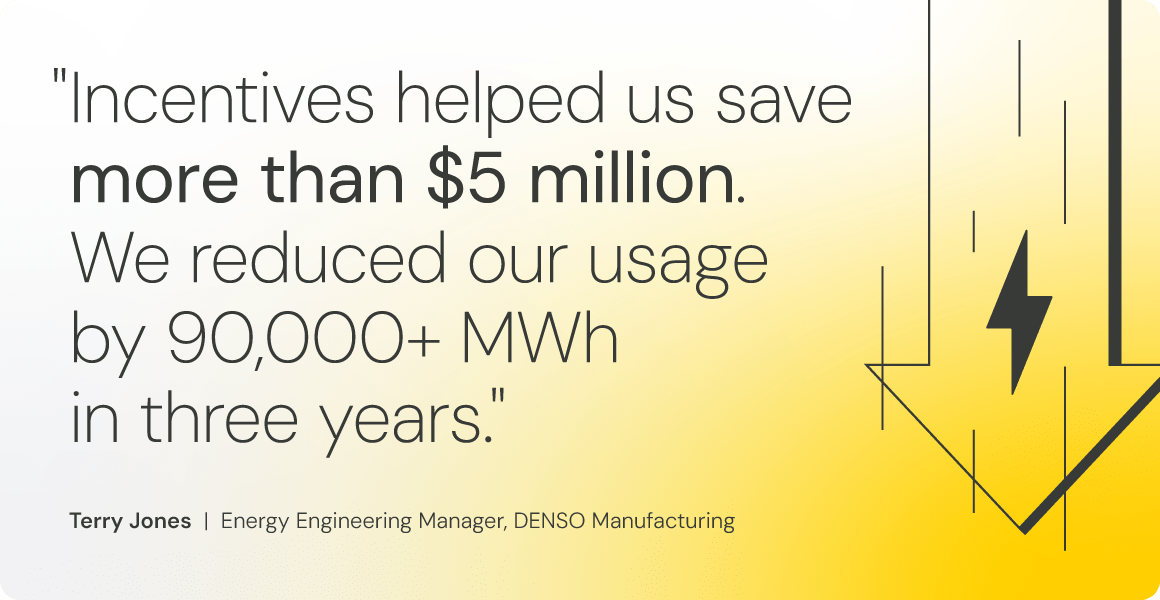
For example, replacing 2,200 fluorescent bulbs with LED lighting, FedEx Supply Chain is projected to save more than 1,754,348 kWh of electricity annually. Not only did they earn a $175,434 incentive from TVA EnergyRight in partnership with local power company Memphis Light, Gas and Water, but FedEx Supply Chain also reduced operational and energy costs by an estimated $150,000 annually.
The incentive earnings help offset project costs and improve overall payback and ROI.
Investing in efficiency is good for your bottom line.
The most successful incentive projects don’t start with paperwork. They start with a real-world challenge — improving efficiency, lowering costs or modernizing operations. Energy incentives simply help make those improvements easier to fund.
For businesses and managers balancing performance, budgets and reliability, that support can make the difference between delaying a project and moving it forward. To learn more about incentive upgrade options for your business, connect with a TVA Energy Expert today.
6 bright ways LED lighting supports workplace productivity.

Cutting operational costs without sacrificing quality or efficiency can be challenging for small to medium-sized businesses. Happily, controlling energy costs and making energy efficiency upgrades is a great way to protect your business’s profit margins while improving your work environment.
Which brings us to LED lighting: Upgrading your lighting systems is one of the most efficient ways to combat escalating operational costs.

And we’re making it easier than ever to brighten your workplace and protect your profits with our Fast Track Lighting incentives!
If you lease your space, you may still be able to upgrade your lighting and save on energy costs. Check out “How to talk to your landlord about energy upgrades” for a few conversation-starters and tips.
Calculate your LED lighting energy savings.
Upgrading inefficient metal halide and fluorescent fixtures to LED lighting can deliver strong financial returns along with meaningful operational benefits.
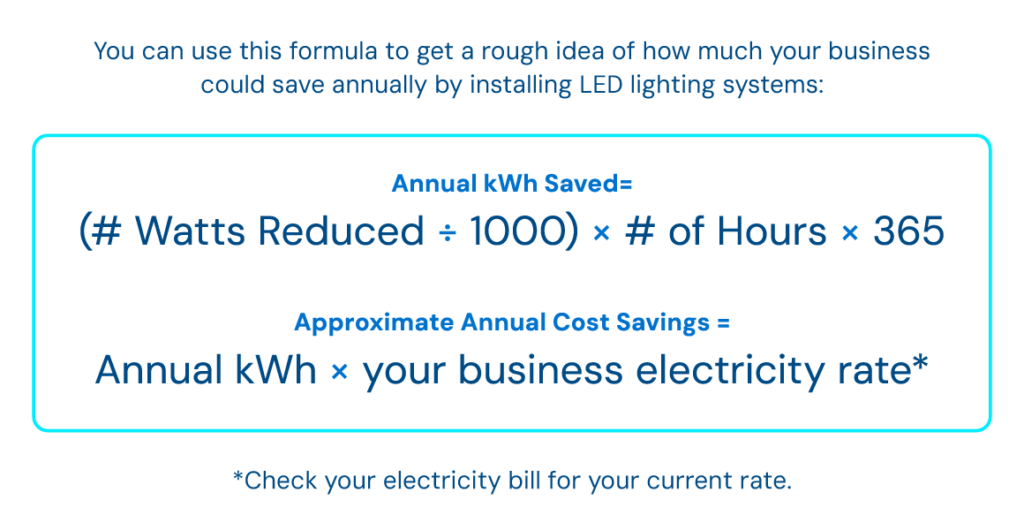
Before we jump into six surprising benefits of LED lighting, let’s take a moment to consider the financial benefits: By implementing a comprehensive upgrade, you can enjoy energy savings of up to 75% with a payback period as short as 6-10 months.
Consider this hypothetical example: A standard 1,000-watt metal halide fixture with ballast consumes 1,150 watts annually, generating over $500 in electricity costs based on 12-hour daily operation at $0.10 per kWh. Over five years, that single fixture costs more than $2,500 to operate.
By comparison, a 300-watt LED replacing a 1,150-watt metal halide system not only provides similar or superior light output but also costs about $130 per year to operate. That’s approximately $650 over five years, for a savings of around $1,850. Please note: These figures do not represent your actual savings and are intended for illustrative purposes only.
Beyond the significant energy savings, LEDs also offer cascading savings over time. For starters, metal halide lights typically last 15,000 hours, while LEDs can last 50,000+ hours. FacilitiesManagement.com also notes that “ballast replacements in traditional systems are extremely expensive, adding another layer of maintenance costs that LEDs eliminate. These shorter light lifecycles and costly ballast failures contribute to significantly higher long-term maintenance expenses and operational complexity.”
We understand that running a small business means watching every dollar — maximizing the ROI of energy efficiency upgrades is a great way to get started. But now, let’s talk about five surprising ways lighting improvements can help boost your business … beyond the bottom line.
1. Improve focus and reduce fatigue.
Dim lighting can cause drowsiness and strain the eyes. On the other end of the spectrum, a well-lit space can reduce eye strain and fatigue, leading to a more focused and engaged workforce (HR Future).
When task areas are well-lit, your employees may make fewer errors and complete visual tasks more quickly. Offices, workshops and retail floors all benefit when light levels are matched to the task — as an example, fine assembly or inspection areas need higher illuminance than a breakroom.
2. LEDs may boost productivity.
LED lights often come equipped with features designed to adapt to the needs of your business. Dimmability options, color temperature flexibility and compatibility with smart lighting systems add to the appeal of LED lighting.
Good lighting conditions and controls contribute to a more vibrant work environment, which can significantly boost employee morale and efficiency. Tasks are completed more accurately and quickly when employees are happy, comfortable and can see clearly, leading to higher quality work and increased productivity.

Modern LED tubes also offer excellent color rendering, which means colors appear more natural and vibrant. This is especially important in environments such as retail stores and workshops, where detail and accuracy are important.
Add lighting controls, such as occupancy sensors, daylight dimming and programmable schedules, into your upgrade mix, and you get light that adapts to real work rhythms: brighter during critical tasks and softer for collaboration or breaks. This flexibility can reduce distractions and support concentration. These features make LED lights not just a functional choice but also a strategic investment in workplace productivity.
Sources: epa.gov; hrfuture.net; pecnw.com
3. Daylight and circadian-aware lighting improve wellness, sleep and alertness
Natural daylight synchronizes circadian rhythms — that’s your internal clock that regulates sleep, alertness and mood. Research shows that employees with good daylight exposure or LED lighting adjusted to the daylight spectrum report better sleep, higher alertness and improved well-being.
Newer “circadian-effective” lighting systems provide blue-enriched daytime light and dimmer, warmer light in the evening that can extend those benefits indoors. It stands to reason that healthier, better-rested employees will be more engaged and productive.
How much can you save?
Calculate your potential savings from incentive-eligible energy upgrades from TVA EnergyRight Business and Industrial Team and your local power company.
4. Improved lighting may lead to a reduction in workplace accidents and injuries.
On shop floors, loading docks, kitchens and construction sites, inadequate lighting increases the risk of slips, trips and costly errors. Industry Today reports that “Poor visibility is the leading cause of slip, trip and fall hazards and contact with moving objects — some of the biggest risks in any facility. LED fixtures produce bright, white, uniform light that improves visibility, and helps workers spot hazards and stay out of harm’s way.”
5. LED lighting can improve employee comfort.
Compared to incandescent bulbs, which release 90% of their energy as heat, and compact fluorescents, which release 80% of their energy as heat, LEDs emit very little heat energy.
This efficiency enables better temperature control in workplaces, which can improve both comfort and safety for your team. Reducing heat waste fosters a more pleasant workspace and decreases the cost of air-conditioning. And finally, the reduced heat output may also contribute to a lower risk of overheating in electronic devices and other critical systems, thereby extending their lifespans and reliability.
6. Brighten your customers’ experience with the LED lighting.
If productivity extends to customer experience (and we think that’s a pretty easy case to make), then it’s worth noting that LED lighting can actively shape how your customers feel the moment they walk through your business’s door. For some retailers, bright lighting makes products look sharper and more appealing. For others, softer tones can create an inviting, comfortable atmosphere that encourages guests to sit back, relax and enjoy the moment.
How TVA EnergyRight and your local power company can help.
For more tips and free energy-saving items such as a smart thermostat, smart plug, weatherstripping and more, request a Business Energy Kit. Some businesses may even qualify for free LED tubes!

Good lighting is an investment in productivity, employee well-being and your business’s bottom line. Learn more about our lighting incentives today.
Renovating or building new? Start with more efficient lighting.

When your business or organization starts planning a renovation, expansion or new construction project, lighting is often treated like a finishing detail. But it’s so much more than that. Better, more efficient lighting starts before your build begins.
Lighting is one of those decisions that shows up everywhere after the project is complete. It affects how much energy a building uses, how comfortable people feel inside the space, how safely employees and visitors move through it, and how often maintenance teams have to get back on lifts or ladders to replace burned-out lamps.
For schools, hospitals, commercial spaces, lighting is more than a line item. It’s part of the operating strategy. And the earlier you consider your lighting choices, the more value it can create.
Why LED lighting belongs in the blueprint.
Energy efficiency is easiest to build into a project before walls are closed, the fixtures are ordered and the budgets are already committed. That is especially true for lighting.
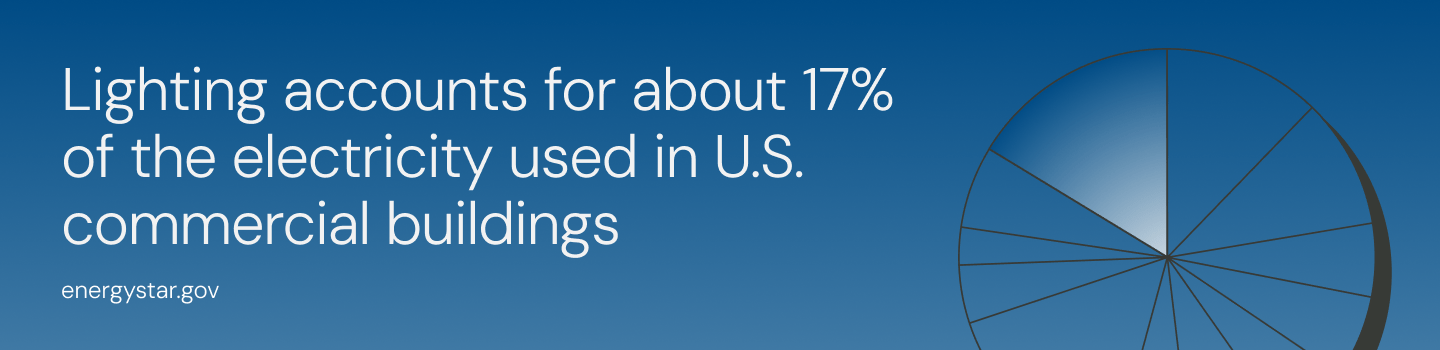
According to ENERGY STAR, lighting accounts for about 17% of the electricity used in U.S. commercial buildings, making it one of the most practical areas to look for energy-saving opportunities. Efficient lighting can help reduce operating costs, improve building performance and create a better environment for the people who use the space every day.
That matters for every business and organization. But it can matter even more for municipalities, universities, schools and hospitals, where facilities must support students, patients, staff, visitors and community members while often operating under tight budgets.
A school renovation is not only about brighter classrooms, and a hospital expansion is not only about meeting codes or replacing outdated fixtures. These projects are opportunities to design spaces that work more efficiently, cost less to operate and support the people inside them.
Did you know that LED lighting provides the same brightness as traditional bulbs but use 90% less energy? LED lighting also lasts 15 times longer, which means big financial savings on operations and maintenance. That combination can make a significant difference over the life of a building, especially in facilities where lights run for long hours or where replacement is difficult, disruptive or expensive.
Better lighting can improve more than energy use.
Lighting affects how people experience a space.
In a retail environment, it can influence how products look and how inviting the space feels. In an office, it can support visibility and focus. In a warehouse or manufacturing facility, it can help teams work more safely and efficiently. In schools, hospitals and public buildings, it can contribute to environments that feel more comfortable, functional and thoughtfully designed.
Research on the built environment continues to show that buildings play a meaningful role in occupant health, comfort and performance. Building conditions, including lighting, can affect occupant well-being and productivity, reinforcing the idea that design decisions should be connected to the people who will use the space every day.
That is the bigger lighting conversation. It’s not just “Which fixtures should we choose?” It’s “How should this space perform?”
Lighting controls can maximize your savings.
Smarter lighting is not only about switching to LEDs. It is also about using the right controls.
Occupancy sensors, daylight-responsive controls, dimming systems and networked lighting controls can help businesses and facilities use light only where and when it is needed. For buildings with variable use patterns, that can be a major advantage.
Advanced lighting and controls can help improve energy savings, occupant satisfaction and building performance. For a business planning a renovation or new build, that means lighting isn’t just a simple fixture swap. It’s a system upgrade. Here are some of the questions to consider when planning lighting for your renovation or new build:
- Where is natural light available?
- Where do people gather?
- Which spaces are occupied all day, and which are used occasionally?
- How should lighting change from morning to evening?
- How can controls reduce waste without making the space feel complicated?
The answers to these questions can help you shape a more efficient, more adaptable building or business.
TVA EnergyRight can help make smart lighting decisions more affordable.
The good news is that businesses and organizations do not have to figure it out alone.
TVA EnergyRight® and local power companies offer lighting incentives that can help reduce upfront costs and make efficient lighting projects more financially attractive. For existing buildings, TVA EnergyRight offers standard lighting incentives for indoor, outdoor and street lighting projects, as well as Fast Track Lighting incentives for qualifying LED replacements that can help move certain retrofit projects forward quickly. There’s no pre-approval required for Fast Track Lighting incentives, and they cover upgrades made within six months of the application.
For new construction, major renovations, expansions and covered parking garages, TVA EnergyRight also offers a New Construction Lighting incentive. This incentive is designed to support efficient lighting decisions early in the building process, when teams have the greatest opportunity to improve long-term performance. That early planning can pay off to reduce energy use, lower maintenance needs and help teams avoid costly redesigns or missed incentive opportunities.
Start with the decision that keeps paying you back.
Renovations and new builds come with plenty of decisions to make. Some affect how a space looks on opening day, while others affect how it performs for years. Lighting does both.
The right lighting strategy can make a building feel better, operate more efficiently and cost less to maintain. It can support employees, students, patients, customers and community members. It can also help businesses and organizations turn an everyday building system into a long-term energy advantage.
So before the fixtures are selected and the plans are finalized, ask a smarter question: How can lighting help this building do more?

TVA EnergyRight and your local power company can help you explore lighting incentives and identify options that support your project goals from the start. To learn more, connect with a TVA Energy Expert today.
Can air sealing and duct system maintenance save you money?

It sure can! As with most things, the better you take care of it, the longer it will last. Cars need to have their oil changed for reliability, air filters need to be replaced to improve air quality, and your home needs air sealing and duct system maintenance for optimal energy efficiency.
That’s not only because air sealing and insulation and duct system maintenance help maintain good indoor air quality and a comfortable home, but also because they support the efficiency of your heating, ventilation and air conditioning (HVAC) system.

When you spring for home air sealing and maintain your duct system, you take unnecessary stress off your HVAC system. This can help lower your monthly energy bill and help reduce the risk of paying for extensive repairs or prematurely replacing a very expensive piece of equipment!
Let’s take a closer look at these important, but often overlooked, areas of home maintenance.
What is air sealing?
Air sealing, sometimes referred to as weatherization, is the process of identifying and sealing any gaps or cracks inside your home or in your home’s exterior where air can sneak in or out. It’s like your home’s very own bouncer, one that blocks uninvited outside air and pollutants from entering so that all the people inside can continue to have a good time!
These gaps and cracks may seem like no big deal, but they can actually have a significant negative impact on your energy bill each month. When your HVAC system is producing all that warm, cozy heat in the winter or cool, conditioned air in the summer, those gaps and cracks are letting all the good stuff right out the literal window.
As conditioned air escapes your home, it forces your HVAC system to run more frequently to maintain your preferred indoor temp, which uses more energy and drives your energy bill up.
The EPA estimates that homeowners can save an average of 15% on heating and cooling costs (or an average of 11% on total energy costs) by air sealing, duct sealing and insulating their homes (ENERGY STAR).
Let’s say your average monthly energy bill is $150, or $1,800 per year. Just by air sealing and insulating your home, you could save around $200! Plus, your HVAC system won’t have to work as hard, which can help extend its overall lifespan.
5 reasons why air sealing your home is a good idea.
Nine out of 10 single-family detached homes in the U.S are under-insulated (ENERGY STAR)! So it’s a safe bet that pretty much all homes (even brand-new builds) could benefit from air sealing, insulation and duct sealing.
Top benefits of air sealing include:
- Saving money by lowering your energy bill.
- Increasing your indoor comfort.
- Blocking outside pollutants.
- Improving the efficacy of your insulation and HVAC system.
- Helping extend the lifespan of your HVAC system.
Combine our home energy rebate on air sealing with rebates on HVAC tune-ups, insulation and duct sealing to increase your total savings.

5 signs your home would benefit from air sealing.
If you’ve never looked at your attic’s insulation, caulked a window or thought about weather stripping, there’s a very, very high probability that your home will benefit from professional air sealing.
Common symptoms of air leaks:
- Visible daylight around doors or windows.
- Visible gaps or cracks around plumbing fixtures and electrical wires.
- Drafty rooms or cold spots.
- Difficulty maintaining your desired temperature.
- Higher than normal energy bills.
The most common places for air leaks in homes.
While some areas of your home might seem like obvious places for air leaks, like around doors and windows, here are a few more areas to explore:
- Pipes and drains
- Electrical sockets
- Light switches
- Recessed lighting fixtures
- Floorboards and floor vents
- Floors, ceilings and walls
- Crawl spaces, attics and basements
- Unheated garages
How to air seal your house.
In general, some areas of a home are easier to seal air leaks than others. If you’re wondering how to air seal your house, you can take a stab at DIY weatherization with a few simple air sealing tools, like weatherstripping, door sweeps, caulk, a caulk gun and some spray foam. These methods are usually simple, straightforward and very affordable.
Professional home air sealing vs. DIY home air sealing.
If DIY isn’t your thing or you’re hoping to reach areas of your home where your DIY skills just won’t go — like adding attic and wall insulation to your air sealing quest — then go with a professional. They’re going to get to those tough-to-reach spots in your crawl space or attic, around recessed lighting and plumbing, or more complex issues around doors and windows.
Everyone’s budget, schedule and confidence with DIY tasks are different. So whether you’re able to hire a professional to air seal your home or would prefer to go the DIY route, you’ll surely feel the benefits of air sealing and duct system maintenance.
Use our Quality Contractor Network to find licensed and insured contractors near you. Vetted by TVA and trained to meet our project quality standards, Quality Contractor Network members can complete your air sealing job and give you direct access to our air sealing home energy rebate or any financing support you might need.

What is duct sealing? (And how is it different from air sealing?)
Now that we’ve tackled air sealing, let’s talk about your home’s ventilation system and ductwork. Like air sealing, duct sealing is another one of those unsung home energy heroes pulling far more weight than you realize.
Your home’s duct system works hand in hand with your heating and cooling unit. So while your heat pump, AC or furnace is busy creating the heating and cooling necessary to get your home to its desired temperature, your duct system is responsible for actually moving that warm or cool air around your home.
Your HVAC systems also work together to maintain indoor air quality, regulating your home’s temperature and humidity while removing pollutants from the air you breathe inside your home. Your duct system has a big job, so ensuring that it operates at peak efficiency is a priority.
5 reasons why you should seal and insulate your duct system.
You can lose 20%-40% of your heating and cooling through air leaks and poor duct insulation. Sealing, insulating or replacing ductwork comes with a number of benefits.
These simple duct fixes can:
- Save money.
- Reduce energy waste.
- Protect the air you breathe.
- Increase your indoor comfort.
- Put less wear and tear on your HVAC system.
Plus, TVA EnergyRight offers a $300 rebate on duct system upgrades so you can enjoy a more energy efficient home at an affordable price.
6 signs your ductwork needs maintenance.
For the most part, your home’s ductwork won’t be visible to you. But just because you can’t see a crack or feel a leak doesn’t mean your home won’t give you helpful signs that maintenance needs to be done.
Ductwork issues to be on the lookout for:
- Higher than normal energy bills.
- Difficulty maintaining your desired temperature.
- Uneven heating and cooling.
- Noticeable dustiness.
- Whistling or whooshing sounds when your HVAC runs.
- Dirt, dust, mold or condensation around air vents.
Professional duct system maintenance vs. DIY duct system maintenance.
While it’s hard to deny the magical powers of duct tape, unless you really know what you’re doing with your duct work, leave maintenance to the professionals. We recommend getting your ductwork cleaned by a professional every two to five years — more frequently if you have furry friends or household members whose health could be affected by negative changes in indoor air quality.
What to expect from a professional duct cleaning:
- Removal of dirt, dust and mold from the supply and return ducts and registers, diffusers and grilles, system coils, drip and drain pan, fan motor and HVAC system cabinetry.
- Identifying and sealing gaps or cracks.
- Cleaning vents and filters.
Even though we recommend hiring a professional to clean your entire duct system, there are still some easy maintenance tasks you can do yourself that will help maintain the integrity of your ductwork and HVAC system.
3 things you can do to help keep your ducts clean:
- Change your air filter at least once every three months.
- Brush off dust and dirt from your air vents and registers.
- Run your bathroom exhaust fan while you shower to prevent moisture buildup and mold.
Air sealing and duct system maintenance can protect your HVAC, save you money and keep you comfy.
An ounce of prevention is worth a pound of cure, especially if it means you can avoid the expensive task of replacing your HVAC system earlier than you anticipated. Air sealing your home and maintaining your duct system pays off. Increase your home’s energy efficiency, lower your energy bills and enjoy a more comfortable home year-round.
Skip the hassle of scrolling through pages of contractor search results! All Quality Contractor Network members are vetted by TVA and trained to meet our project quality standards. Plus, we offer a free job inspection by a TVA-certified Home Energy Advisor for added peace of mind.
Find a TVA-vetted contractor and get home energy rebates today.
Search the Quality Contractor Network for free and find TVA-vetted contractors near you.
Fun science for kids: It’s not the heat, it’s the humidity!

Ever step outside on a hot day and feel it right away? If your skin feels sticky and your hair starts to frizz before you’ve even left the porch, it’s probably humidity.
So what is humidity? It’s the invisible water vapor (it’s a little like fog that you can’t see) floating in the air all around you. In the winter, lack of humidity — dry air — can make your skin feel dry and flaky. It can even give some kids bloody noses. YUCK!
In the summertime, high humidity makes the heat feel way hotter. It also makes your air conditioner work way harder! Today, we’re going to learn a little bit more about how humidity works and how to measure it with three super-fun experiments you can do right in your own backyard.
- Build a hygrometer or a psychrometer.
- Conduct a wet bulb test.
- Create your own backyard weather station!
Let’s build a hygrometer.
Warm air can hold more water vapor than cool air. When the air is packed with moisture, sweat doesn’t evaporate off your skin as fast as it does when the air around you is drier — so you feel hotter and stickier.
Scientists measure humidity with a tool called a hygrometer (hi-GROM-eh-ter). The number it gives you is called relative humidity, and it’s usually shown as a percentage. So 100% means the air is completely saturated with moisture, and it probably feels pretty gross outside. On the other hand, 1% humidity is really, really dry!
Fun fact: If it’s 90°F with low humidity, it might feel like 90°F. Add in high humidity, and it can feel like 105°F!
Meteorologists call this “feels like” difference the heat index — and it’s why people in our seven-state Tennessee Valley region complain so much about muggy summer days.
Build a pine cone hygrometer.
Pine cones are nature’s own humidity detector! Their scales — the little “petals” that form the cone open up when the air is dry and snap shut when it’s humid. Pine trees scatter their seeds by opening so the seeds can float on the breeze and fall to the ground. Their seeds have the best chance of surviving when they can travel far away from the original tree. And they can’t travel very far when it’s too wet outside. So that’s why the cones close when it’s humid and open up when it’s dry!
What you need:
- 3 dry, fully open pine cones
- A piece of cardboard
- A marker
- String (to hang it outside)
Steps:
- Start with fully open (dry) pine cones. (You may need to dry them out inside for a couple of days so they can open up.)
- Carefully tie a piece of string or yarn around the base of one of the cones.
- Hang the pine cone with the string tied around it from a tree branch.
- Put another pine cone on a windowsill.
- Put the third cone in a shallow bowl of water.
- Observe how the pine cones change each day and record your observations.
SOURCES: littlebinsforlittlehands.com, treejourney.com, science-sparks.com
Build a psychrometer.
A psychrometer (si-KROM-ih-ter) uses two thermometers. One of them should be dry, and the other one should have a wet cloth or cotton ball wrapped around it. These are the tools you’ll need to calculate relative humidity. When water evaporates from the wet one, it cools down. The bigger the gap between the two temperatures, the drier the air!
What you need:
- 2 matching thermometers
- A small piece of cotton cloth (or thin sock fabric)
- Water
- Tape and a piece of cardboard
- A notebook to record results
Steps:
- Tape both thermometers side by side on a piece of cardboard.
- Wrap a small piece of damp cotton gauze or a damp cotton ball snugly around the bulb of one thermometer. This is your “wet bulb.”
- Gently wave them around for 2–3 minutes. (Waving them speeds up evaporation.)
- Read and record both temperatures. The wet bulb will be lower!
- Look up a psychrometric chart online: Enter your dry bulb and wet bulb temperatures to get your relative humidity percentage.
If both temperatures are nearly the same, the air is very humid. A big difference between the two? It’s a dry day!
If you have enough people and enough thermometers, use one to measure indoor humidity and another pair to measure outdoor humidity.
SOURCE: sciencebuddies.org, teachengineering.org
Build your own backyard weather station!
Now put all your humidity knowledge together and become your neighborhood’s youngest meteorologist! Combine your pine cone hygrometer, your psychrometer, and a basic outdoor thermometer into one station. Track temperature, humidity and sky conditions every single day.
Keep a daily log and be sure to record these data points every morning:
- Date and time
- Outdoor temperature
- Pine cone status: open, partially open, or closed?
- Wet bulb and dry bulb readings (and your calculated humidity %)
- Sky description: clear, partly cloudy, overcast, rainy?
After two weeks, review your data. Can you spot any patterns? Try making a simple bar graph showing how humidity changed through the week.
Bonus challenge: Compare your pine cone readings to the official forecast. How often was your pine cone right?
What does this have to do with energy efficiency and staying cool?
Your air conditioner doesn’t just cool the air; it also removes moisture. Which we now know is called humidity! On super-humid days, your AC has to work extra hard, which uses more electricity and costs your family more money. Newer, high-efficiency HVAC systems are specially designed to pull humidity out of the air faster and more efficiently, keeping everyone comfortable while helping your family save money.
Now that you understand humidity, you understand one of the biggest reasons why a good AC and a well-maintained HVAC system matters! Be sure to tell your family about rebates on things like air conditioning, heat pumps and insulation!
How SEER2 15+ energy efficient air conditioners handle heat and humidity.

Energy efficient air conditioners that tackle our region’s tough conditions.
Replacing or upgrading your AC with a SEER2 15+ energy efficient air conditioner may not be as exciting as a cool summer road trip to an icy northern lake, but if you’re tired of sweltering inside your own home, it could be a close second.
Whether your family has lived in the Tennessee Valley for generations or you’re experiencing your first summer in our beautiful seven-state region, you know — or you’ll soon discover — that heat and humidity are the area’s dynamic discomfort duo. They’re tough on you, and they put the hurt on your home’s AC unit.
Fortunately, modern air conditioning technology helps maintain comfortable indoor humidity levels and consistent indoor comfort during peak heat season. Understanding what SEER2 means and why a SEER2 15+ system can help you save money on energy costs year after year is what this article is all about.
You can read from start to finish or click on a link below to jump to sections that you’re most interested in.
What does SEER2 mean and why does it matter for your home?
SEER2 vs. SEER: what changed and why it matters.
What’s a good SEER rating?
Why high humidity makes your home feel hotter.
How heat and humidity impact your AC system.
What’s a variable-speed compressor, and how are they different from single-stage compressors?
Is it time to upgrade or replace my air conditioner?
What does SEER2 mean, and why does it matter for your home?
What is SEER2? Glad you asked! We’ve already written about the top 4 benefits of higher SEER2 ratings, but read on for a more detailed explanation.
SEER2 stands for Seasonal Energy Efficiency Ratio 2. Think of it as the miles-per-gallon rating for your air conditioner (or heat pump): The higher the number, the more you save on energy.
The new SEER2 rating went into effect a couple of years ago, but lots of homeowners are just now learning about the new ratings. In fact, you may continue to notice products marked with both a SEER and SEER2 ratings while manufacturers adopt the new standards.
So what does SEER2 do, exactly? It measures your system’s total cooling output over a season divided by the total energy it uses to get there. A higher SEER2 rating means your system works smarter, not just harder — and that translates directly into lower cooling costs for your household.
Curious about how SEER2 is calculated? We asked our experts, and you can find the answer in our SEER2 FAQs.
SEER2 vs. SEER: What changed and why it matters.
The original SEER system has been in use since 1992 and measures efficiency under controlled, laboratory-style conditions. SEER2 uses a more realistic testing method that accounts for real-world factors such as ductwork resistance, filters, registers and variable outdoor conditions that actually affect how your system performs day-to-day.
Because the SEER2 testing conditions are more realistic, SEER2 numbers are typically lower than the old SEER numbers for the same equipment.
It’s worth pointing out that SEER2 ratings are generally 4%-5% lower than equivalent SEER ratings for the same equipment. This doesn’t mean the equipment is less efficient! What it really means is that the testing is more realistic.
What’s a good SEER2 rating for energy efficient air conditioners?
Taking our region’s heat and humidity demand into consideration, the Department of Energy recommends a minimum of 13.4 SEER2 for new packaged air conditioners (ICCsafe.org). However, selecting a unit with a higher rating means even greater savings.
A 20 SEER2 system is approximately 54% more efficient than a 13 SEER2 system. For a typical 3-ton system in the Southeast running 2,000 hours annually at $0.15/kWh, upgrading from 13 SEER2 to 20 SEER2 could yield 10-year savings of nearly $3,000.
Why high humidity makes your home feel hotter.
Before we get into how your AC system handles all of this, it helps to understand what’s actually happening inside your home when humidity is high. You know, during May, June, July, August, September and bits of October.
It’s the humidity, not the heat! Really. Your body cools itself through perspiration and the evaporation of that perspiration. However, when the air is already saturated, evaporation slows, and your body can’t cool itself as effectively as it can when humidity levels are low. That’s why a 90° F day with 85% humidity feels much “hotter” than a 98° F day with drier air. But we’re not advocating for moving to Arizona, we’re looking at new air conditioners!
Comfortable indoor humidity levels generally fall between 30% and 50%. For those of you with stringed, fretted instruments, humidity closer to 50% is ideal. When your home’s humidity creeps above that range, everything feels sticky and heavy — even if your thermostat is telling you something else.
You may find yourself grumping, “Why does my house feel humid with the AC on?” The answer could be that your system is short-cycling — something that happens as units age or if your system isn’t properly sized to your home. When a system turns off before it’s done its dehumidifying job, then your home will feel sticky no matter what the thermostat tells you.
Your discomfort might also be rooted in poor airflow or running a system that isn’t designed to handle our region’s intensely hot and humid summers.
If you’re not sure what the culprit is, look for a trusted contractor who can help you get to the root of your discomfort and make recommendations tailored to your home and your comfort needs. You can search our Quality Contractor Network for free.

How heat and humidity impact your AC system.
If heat and humidity are the dynamic discomfort duo, then your air conditioner is the supercooling wonder of the HVAC world: It lowers the temperature in your home and removes moisture from the air.
When an AC system runs, warm air passes over the cold evaporator coil. That coil does double duty by lowering the air temperature and causing water vapor to condense from the air. Basically, it works the same way a cold glass of lemonade “sweats” on a humid afternoon, cooling the air around it.
That collected moisture drains away, leaving your home with drier, cooler air.
Unlike with burgers and boxes of chocolate, bigger isn’t always better when it comes to your AC. If your system is too large for your home, it cools the air quickly but shuts off before it’s had time to pull adequate moisture out. This is when your thermostat tells you one thing, but your body is telling you an entirely different story.
Uneven cooling — hot or cold spots from room to room, or one floor that’s never quite right — is another common sign that your system is working inefficiently or isn’t well-matched to your home.
Reliable cooling in extreme heat means your system should be able to run long enough to manage both temperature and humidity — not just race to hit a number on the thermostat and shut off.
What’s a variable-speed compressor, and how are they different from single-stage compressors?
A single-stage compressor is a lot like a new puppy: It’s either running full blast or it’s off. A variable-speed compressor is more like a well-trained, middle-aged retriever: It speeds up or slows down to match your needs.
In terms of your air conditioner, a variable-speed compressor cruises at low speed during moderate days, sipping power. When the heat and humidity hit hard, it ramps smoothly. This modulation cuts wasteful on/off cycling, reduces electrical stress at startup and holds steadier indoor temperatures. The result is higher SEER2 efficiency, fewer temperature swings, less wear on parts and lower cooling costs over time.
Although some 15 SEER2 air conditioners use variable-speed compressors, most of them do not. However, most 17 SEER2+ systems incorporate variable-speed compressors and advanced, energy efficient condenser technology.
Is it time to upgrade to an energy efficient air conditioner?
According to the Department of Energy, replacing a 10-year-old unit with a newer, more efficient model can save you up to 20% on cooling costs. When you combine that with a rebate from TVA EnergyRight and your local power company, the savings are even greater!
With proper care (check out this blog for more information on tune-ups: “8 reasons why seasonal residential HVAC maintenance is a good idea”), most HVAC systems can last between 15 and 20 years. Unfortunately, however, efficiency and efficacy drop significantly well before a system reaches the end of its life. A 10- or 12-year-old system may still be running, but it’s likely working harder and costing you more than a modern replacement would.
As you make a decision about whether or not it’s time to replace your air conditioner, consider your answers to these questions:
- Is your home consistently uncomfortable, even when the AC is running?
- Do you notice hot or cold spots in your house?
- Does your AC keep every room comfortable?
- Has your energy bill crept upward over the past few summers without a clear explanation?
- Is your system more than 10 years old?
- Are repairs becoming more frequent or more expensive?
If you answered yes to several of these, it may be time to schedule a Home Energy Evaluation or have a TVA-vetted contractor from the Quality Contractor Network evaluate your current system and discuss your options.
Rebates are available on energy efficient central air conditioning systems.
If you’re ready to upgrade, TVA EnergyRight and your local power company are ready to help make it more affordable. We’re offering a $400 rebate on 17 SEER2 or higher systems and $200 on 15-16.99 SEER2 units.
Our rebates are available on systems installed by a member of the Quality Contractor Network. They’ll even submit the paperwork for you!