
Renovating or building new? Start with more efficient lighting.

When your business or organization starts planning a renovation, expansion or new construction project, lighting is often treated like a finishing detail. But it’s so much more than that. Better, more efficient lighting starts before your build begins.
Lighting is one of those decisions that shows up everywhere after the project is complete. It affects how much energy a building uses, how comfortable people feel inside the space, how safely employees and visitors move through it, and how often maintenance teams have to get back on lifts or ladders to replace burned-out lamps.
For schools, hospitals, commercial spaces, lighting is more than a line item. It’s part of the operating strategy. And the earlier you consider your lighting choices, the more value it can create.
Why LED lighting belongs in the blueprint.
Energy efficiency is easiest to build into a project before walls are closed, the fixtures are ordered and the budgets are already committed. That is especially true for lighting.
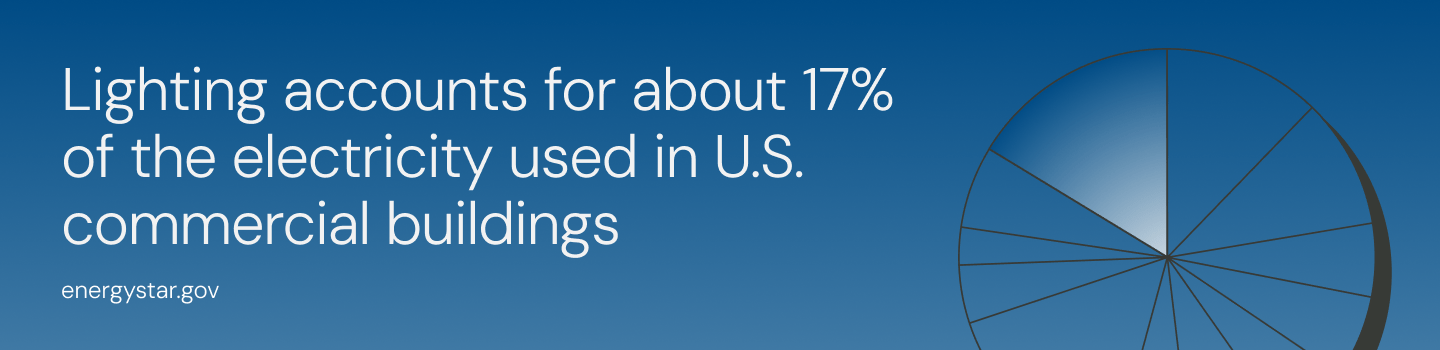
According to ENERGY STAR, lighting accounts for about 17% of the electricity used in U.S. commercial buildings, making it one of the most practical areas to look for energy-saving opportunities. Efficient lighting can help reduce operating costs, improve building performance and create a better environment for the people who use the space every day.
That matters for every business and organization. But it can matter even more for municipalities, universities, schools and hospitals, where facilities must support students, patients, staff, visitors and community members while often operating under tight budgets.
A school renovation is not only about brighter classrooms, and a hospital expansion is not only about meeting codes or replacing outdated fixtures. These projects are opportunities to design spaces that work more efficiently, cost less to operate and support the people inside them.
Did you know that LED lighting provides the same brightness as traditional bulbs but use 90% less energy? LED lighting also lasts 15 times longer, which means big financial savings on operations and maintenance. That combination can make a significant difference over the life of a building, especially in facilities where lights run for long hours or where replacement is difficult, disruptive or expensive.
Better lighting can improve more than energy use.
Lighting affects how people experience a space.
In a retail environment, it can influence how products look and how inviting the space feels. In an office, it can support visibility and focus. In a warehouse or manufacturing facility, it can help teams work more safely and efficiently. In schools, hospitals and public buildings, it can contribute to environments that feel more comfortable, functional and thoughtfully designed.
Research on the built environment continues to show that buildings play a meaningful role in occupant health, comfort and performance. Building conditions, including lighting, can affect occupant well-being and productivity, reinforcing the idea that design decisions should be connected to the people who will use the space every day.
That is the bigger lighting conversation. It’s not just “Which fixtures should we choose?” It’s “How should this space perform?”
Lighting controls can maximize your savings.
Smarter lighting is not only about switching to LEDs. It is also about using the right controls.
Occupancy sensors, daylight-responsive controls, dimming systems and networked lighting controls can help businesses and facilities use light only where and when it is needed. For buildings with variable use patterns, that can be a major advantage.
Advanced lighting and controls can help improve energy savings, occupant satisfaction and building performance. For a business planning a renovation or new build, that means lighting isn’t just a simple fixture swap. It’s a system upgrade. Here are some of the questions to consider when planning lighting for your renovation or new build:
- Where is natural light available?
- Where do people gather?
- Which spaces are occupied all day, and which are used occasionally?
- How should lighting change from morning to evening?
- How can controls reduce waste without making the space feel complicated?
The answers to these questions can help you shape a more efficient, more adaptable building or business.
TVA EnergyRight can help make smart lighting decisions more affordable.
The good news is that businesses and organizations do not have to figure it out alone.
TVA EnergyRight® and local power companies offer lighting incentives that can help reduce upfront costs and make efficient lighting projects more financially attractive. For existing buildings, TVA EnergyRight offers standard lighting incentives for indoor, outdoor and street lighting projects, as well as Fast Track Lighting incentives for qualifying LED replacements that can help move certain retrofit projects forward quickly. There’s no pre-approval required for Fast Track Lighting incentives, and they cover upgrades made within six months of the application.
For new construction, major renovations, expansions and covered parking garages, TVA EnergyRight also offers a New Construction Lighting incentive. This incentive is designed to support efficient lighting decisions early in the building process, when teams have the greatest opportunity to improve long-term performance. That early planning can pay off to reduce energy use, lower maintenance needs and help teams avoid costly redesigns or missed incentive opportunities.
Start with the decision that keeps paying you back.
Renovations and new builds come with plenty of decisions to make. Some affect how a space looks on opening day, while others affect how it performs for years. Lighting does both.
The right lighting strategy can make a building feel better, operate more efficiently and cost less to maintain. It can support employees, students, patients, customers and community members. It can also help businesses and organizations turn an everyday building system into a long-term energy advantage.
So before the fixtures are selected and the plans are finalized, ask a smarter question: How can lighting help this building do more?

TVA EnergyRight and your local power company can help you explore lighting incentives and identify options that support your project goals from the start. To learn more, connect with a TVA Energy Expert today.
Related stories
-
 Business & Industry
Electrification versus efficiency: Where should industrial facilities focus first?
View moreAccording to the U.S. Department of Energy (DOE), the industrial sector accounts for about one-third of U.S. energy-related carbon dioxide emissions, making industrial energy strategy a high-impact area. As industrial facilities look for ways to meet sustainability goals, optimize operations and invest in energy efficiency, moving certain equipment and processes to electricity can potentially be […]
-
 Business & Industry
The hidden cost of running systems after hours.
View moreYour business space is often “on” when no one’s there. Many businesses focus on what happens during operating hours, but the biggest waste may happen when no one is there to notice it. Lights stay on, HVAC systems keep empty rooms heated or cooled and temporary overrides become permanent habits. After-hours energy use is easy […]
-
 Business & Industry
Offset costs and increase your ROI: Incentives for equipment upgrades explained.
View moreA guide to how energy incentives support real projects, reduce costs and improve ROI. Utility energy incentives for equipment upgrades can seem complicated from the outside. Many businesses and organizations assume they involve lengthy applications, rigid requirements or projects designed specifically to qualify. But if you take a closer look, you’ll see that incentives are […]