
Understanding air source heat pumps: Your guide to comfort and savings.

If you’re starting to think about replacing your aging heating and cooling system or you’re interested in making your home more energy efficient, you’ve probably come across the terms “air source heat pump” and “dual fuel heat pumps” more than once. If you’re still wondering which one is right for you, this blog should help!
Let’s break it down together in a way that makes good energy sense.
What is an air source heat pump?
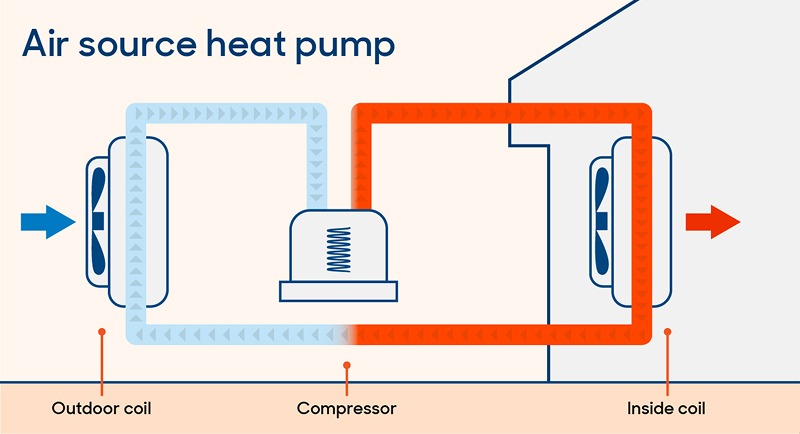
An air source heat pump is an all-electric system that keeps your home comfortable year-round by moving heat from one place to another.
Think of it like this: Your refrigerator doesn’t make cold air. It pulls heat out of the fridge and releases it into your kitchen. An air source heat pump does the same thing, just on a much bigger scale.
In the summer, it removes heat from inside your home and releases it outside, keeping you cool.
In the winter, it pulls heat from the outdoor air (yes, even when it’s cold outside!) and brings it inside to warm your home.
According to the U.S. Department of Energy, when properly installed, an air source heat pump can deliver up to two to four times more heat energy to a home than the electrical energy it consumes, because it transfers heat rather than converting it from fuel.
Because it’s moving heat around instead of burning fuel to generate it, an air source heat pump uses far less energy than many traditional systems. And that can mean real savings on your energy bills — which is something we can all appreciate.
A system that does it all.
Right now, many homes rely on two separate pieces of equipment: A furnace to keep you warm and an air conditioner to keep you cool.
An air source heat pump combines both jobs into a single system — with an external condenser unit and an furnace/air handler inside. That means:
- One piece of equipment heating your home.
- One piece of equipment cooling your home.
- One thermostat controlling everything.
This streamlined setup can make life easier. You have fewer systems to maintain, fewer service calls to schedule, and when it’s time to replace aging equipment, you can upgrade everything at once.
If your furnace or air conditioner is starting to show its age (most HVAC systems last 15-20 years), switching to an air source heat pump gives you a chance to replace both with one high-efficiency solution.
Designed for steady, even comfort.
Have you ever noticed how older heating and cooling systems can make your home feel like it’s sticky one minute and icy the next — blasting hot or cold air, then shutting off completely? It can leave some rooms feeling perpetually stuffy, while other rooms feel as though they could keep ice cream from melting.
There’s a fix for that. Many modern air source heat pumps use variable-speed technology. Instead of being “on” or “off,” the system runs at different levels to keep your home consistently comfortable.
This helps:
- Maintain steadier indoor temperatures throughout the day.
- Reduce those annoying hot and cold spots in different rooms.
- Deliver quieter operation, so you hardly notice it’s running.
Rather than cycling on and off in big bursts, the system makes small, gentle adjustments. For many families, this creates a calmer, more balanced indoor environment — which means fewer complaints about being too hot or too cold.
Works in all kinds of weather.
You might be wondering: “But what about winter? Can a heat pump really keep my home warm when it’s cold outside?”
Great question — and the answer is yes.
Today’s air source heat pumps are far more advanced than earlier models. According to the Department of Energy, cold climate air source heat pumps can reduce household energy consumption by up to 40%, and they’re designed to work effectively even in regions with extended periods of subfreezing temperatures.
Technology improvements in compressors, controls and refrigerants have made modern heat pumps a realistic option for homes across many climates — not just warm Southern states.
That means your heat pump can:
- Provide efficient cooling in summer.
- Deliver reliable heating in winter.
- Adjust automatically as outdoor temperatures change throughout the year.
All-electric and energy efficient.
Air source heat pumps run on electricity, not natural gas, propane or oil. And because they move heat instead of creating it, they’re incredibly efficient.
The Department of Energy notes that ducted air source heat pumps can reduce your electricity use for heating by up to 75% compared to electric resistance heating such as furnaces and baseboard heaters.
For homeowners, this can mean:
- Lower overall energy use and smaller utility bills.
- Reduced dependence on delivered fuels like propane or oil.
Every home is different, but many families notice improved efficiency and comfort after making the switch.
Built to save you money over time.
Energy efficiency isn’t just about this month’s bill. It’s about choosing equipment that performs well year after year — and helps you save money in the long run.
Air source heat pumps are designed with this long-term performance in mind and rely on:
- High-efficiency compressors that use less energy.
- Smart controls that adjust based on real-time conditions.
- Fewer energy losses compared to combustion-based systems.
Over time, these features add up to:
- Lower monthly utility bills.
- Less wasted energy.
- A better return on your investment.
Air source heat pumps vs. dual fuel systems: What’s the difference?
We promised you we’d hit on the differences between air source and dual fuel heat pumps, and here we are! (If you want a deeper dive into dual fuel heat pumps, check out this blog.)
They’re related, they’re not the same thing.
Air source heat pump:
- All-electric system.
- Provides both heating and cooling.
- Uses electricity year-round.
- Moves heat rather than generating it.
Dual fuel heat pump (AKA hybrid heat pump):
- Combines an air source heat pump with a gas or propane furnace.
- Uses the heat pump during milder temperatures.
- Automatically switches to the furnace during very cold conditions.
In other words, a dual fuel system includes an air source heat pump plus a backup furnace for extra cold days.
Why some homeowners choose an air source heat pump:
Many homeowners prefer a standalone air source heat pump because they:
- Want an all-electric home heating and cooling system.
- Don’t have access to natural gas service.
- Prefer fewer mechanical components to maintain.
- Are focused on maximizing energy efficiency.
According to EnergyRight.com, air source heat pumps can save you hundreds of dollars in heating costs each year. For many homes, a properly sized air source heat pump can handle both heating and cooling needs without needing any additional equipment.
Why some homeowners choose a dual fuel system.
Other homeowners lean toward a dual fuel approach because it:
- Adds a second heating source for extremely cold days.
- Provides extra peace of mind if they live in a region with harsh winters.
- Offers flexibility between electricity and gas, depending on energy costs.
Homes with existing gas service — or those in areas where winter temperatures regularly dip well below freezing — sometimes benefit from having both options available.
There’s no one-size-fits-all answer.
The best system for your home depends on your home’s size, layout and construction; insulation quality and air sealing; existing ductwork and utilities; and source of energy.
The good news? You don’t have to figure this out alone. A TVA-vetted member of the Quality Contractor Network can evaluate your unique situation and help you determine whether an air source heat pump or a dual fuel system makes the most sense for your family.
Simple steps to get started.
You don’t have to decide anything today. Getting informed is a great first step, and you’re already doing that by reading this.
Here’s how to move forward when you’re ready:
- Check the age of your current HVAC equipment — If it’s over 10-15 years old, it might be time to start planning for a replacement.
- Schedule an HVAC tune-up or evaluation — An HVAC professional can help you understand your home’s needs and provide a range of options.
- Ask about air source heat pump and dual fuel options — Get personalized recommendations based on your situation.
- Explore available rebates!
TVA EnergyRight® and your local power company can help connect you with trusted contractors from the Quality Contractor Network and available savings opportunities.

An efficient path forward.
Choosing a new heating and cooling system is a big decision — and you deserve to feel good about it.
Air source heat pumps offer an efficient, reliable way to keep your home comfortable year-round using one integrated system. For many homeowners, they provide steady comfort, lower energy use and peace of mind knowing their home is ready for the future.
Whether you ultimately choose an air source heat pump or a dual fuel system, understanding your options puts you in control. And you don’t have to navigate this alone — TVA EnergyRight® and your local power company are here to help you take the next step with confidence.
Click around our website to learn more about rebates, find a vetted contractor and start your journey toward a more comfortable, energy-efficient home.
You’ve got this — and we’re here to support you every step of the way.
Related stories
-
 Residential
What to expect from a free Home Energy Evaluation.
View moreA professional home energy audit — like our Home Energy Evaluation — is a great first step in assessing how much energy your home uses and figuring out what to do about it. Maybe you’re surprised by how much energy your home uses, perhaps you’re mystified by a draft in the hallway. Or, maybe you’re […]
-
 Residential
5 ways to maximize the efficiency of your heat pumps and ductless mini splits.
View moreIf your HVAC system is 10-15 years old and you’re proactively considering replacing it, you may be exploring heat pumps. Ductless mini splits as well as ducted dual fuel and air source heat pumps are all great options for our seven state region. As you consider your HVAC replacement options, here are a few practical […]
-
 Residential
What’s a dual fuel heat pump?
View moreWhen the weather can’t commit, your heat pump can. Here in the Tennessee Valley region, we’re all quite familiar with weeks that keep you on your toes temperature-wise. You know, those weeks when Mondays have you ramping up the air conditioning and Wednesday has you firing up the heat. Don’t even get us started on […]